Affiliate Disclosure:Home Vacuum Zone is reader-supported. When you buy through links on our site, we may earn an affiliate commission at no additional cost to you. This does not influence our reviews or recommendations — we only recommend products we genuinely believe in.
Karcher vs Craftsman: Wet/Dry Shop Vac Showdown 2026
Both of these shop vacs end up on workshop floors. They both vacuum wet, they both vacuum dry, they both blow leaves when you flip the hose to the other port. The price tags and build philosophies tell you everything about who they’re for. The Craftsman CMXEVBE17596 16-Gallon is the value workhorse, twice the Karcher’s capacity for roughly half the price. The Karcher WD 6 P S is the premium pick, with stainless engineering and a power-tool outlet that woodworkers actually use.
If you’re choosing between these two, the question isn’t really “which is better” because the answer depends on what you’re cleaning. A roofer with a basement to flood-clean and a Craftsman 16-gallon is going to laugh at anyone pulling out a Karcher. A woodworker hooking up dust extraction to a mitre saw is going to laugh at anyone trying to run that off a Craftsman without auto start/stop. Different jobs, different tools.
So here’s what actually matters when you’re choosing.
Quick Comparison
| Spec | Karcher WD 6 P S | Craftsman CMXEVBE17596 |
|---|---|---|
| Capacity | 8 gallons (30 L) | 16 gallons |
| Peak HP | 6.2 HP | 6.5 HP |
| Tank material | Stainless steel | Plastic |
| Drain plug | Yes | No |
| Hose length | 11.5 ft | 7 ft |
| Cord length | 26 ft | 20 ft |
| Total reach | 37 ft | 27 ft |
| Filter system | Pleated cartridge + 3-layer fleece bag | Qwik Lock cartridge |
| Semi-auto filter cleaning | Yes (pulsed air) | No |
| Power tool outlet | Yes (auto start/stop) | No |
| Wand material | Stainless steel | Plastic |
| Weight | 21.8 lbs | ~20 lbs |
| Noise level | ~80 dB (Trusted Reviews) | ~87 dB typical |
| Warranty | 2 years | Limited |
| Amazon price | ~$280 | ~$130 |
Most rows favour the Karcher on refinement. Two rows favour the Craftsman, capacity and price, and both of those are massive.
Karcher WD 6 P S
The WD 6 P S is what happens when German engineers build a shop vac and then keep adding the small improvements that competitors leave on the table. The stainless steel tank doesn’t crack when dropped or degrade in sunlight. The drain plug means you can empty dirty water without tipping a 20-pound canister over your boots. The extension wands are also stainless steel, so they survive being trodden on in a way that plastic wands don’t.
The two genuine features that Craftsman has no answer for are semi-automatic filter cleaning and the power-tool outlet. Push the filter-cleaning button mid-job and a burst of pulsed air clears dust out of the pleated cartridge without taking the lid off. If you’ve ever stopped a workshop cleanup to bang dust out of a clogged filter, you know why this matters. The power-tool outlet on the back of the unit has auto start/stop, plug a sander in, pull the trigger, the vac fires up. Stop cutting, the vac clears the hose then shuts off. Two switches become one.
Suction-wise, the WD 6 P S puts down 265 air watts (Trusted Reviews measurement), which is genuine premium-tier airflow. It locks onto carpet at full power. The 11.5-foot hose plus 26-foot cord gives 37 feet of total reach, useful in larger workshops where you don’t want to keep moving the canister.
The catches: 8 gallons fills faster than you’d expect on a serious cleanup, and you’re paying more than double the Craftsman price for a machine that holds half as much. Replacement filter bags also cost more than generic shop vac consumables. If raw capacity is your priority, this isn’t the machine.
Craftsman CMXEVBE17596 16-Gallon
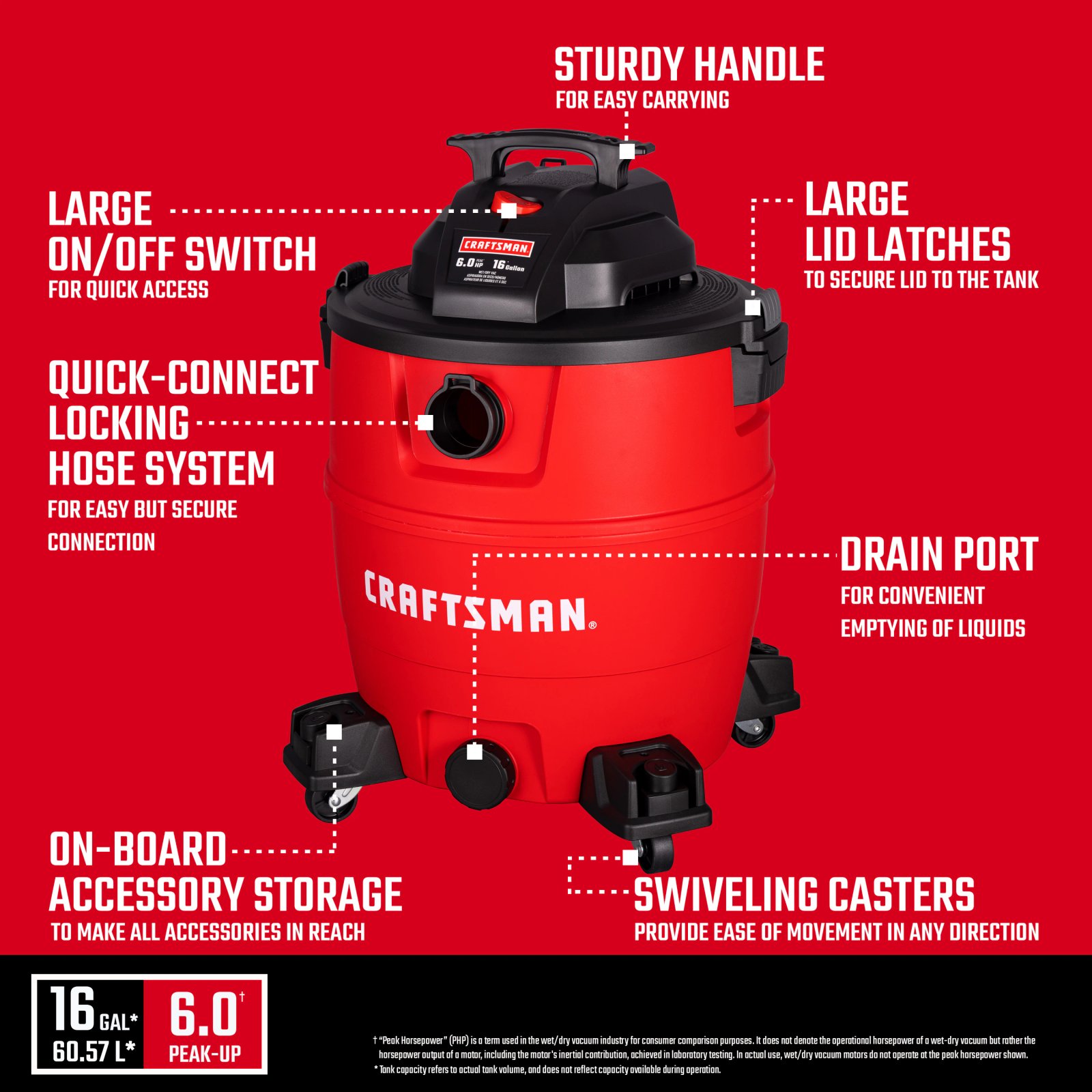
The Craftsman is the shop vac equivalent of a pickup truck. It’s not subtle, it’s not elegant, but it does the heavy work for half the money. The 16-gallon drum handles entire basement floods or full workshop cleanups before needing to be emptied. The 6.5 peak HP motor pulls strong on both wet and dry messes, comparable in real-world cleaning to the Karcher despite the slightly different HP rating.
The Qwik Lock filter system is the standout ergonomic win. Filter changes are genuinely tool-free, swap cartridge to foam sleeve when going wet, swap back for dry. This matters more than you’d think because most shop vac filter changes require fumbling with metal clips and gaskets that aren’t quite cooperative.
The blower port flips the hose to the rear so the vac doubles as a leaf blower or inflator. Useful for clearing sawdust off a workbench or blasting leaves off a porch. Four casters (two locking) give stable mobility on workshop floors, though the 25-pound full weight gets tiring to haul up stairs.
Where it gives ground: the 7-foot hose feels short on big jobs, often requiring you to move the canister rather than just walking around with the wand. The 20-foot cord plus 7-foot hose limits you to 27 feet of reach, not much in a 2-car garage with the outlet at one end. There’s no drain plug, so emptying water means tipping the whole 16-gallon canister, which is a two-person job when it’s full. And there’s no power-tool outlet, so dust extraction from tools means flipping the vac switch manually every time.
Build quality is plastic. It will eventually crack if you drop it on a concrete floor or leave it baking in summer sun. Most owners get 5-8 years out of it for occasional use. That’s fine for a $130 tool, but the Karcher with its stainless construction will likely outlast it by years.
Capacity & Power
Capacity is the headline difference and the easiest place to start. 16 gallons of debris is genuinely twice 8 gallons, and on big cleanup jobs this matters. A full garage tidy, a basement spill, a kitchen renovation cleanup, the Craftsman handles these in one go where the Karcher needs at least one empty mid-job.
Peak horsepower numbers (6.5 vs 6.2) are marketing figures, not real continuous power ratings. In actual airflow terms, the Karcher’s measured 265 air watts at the hose is the more reliable performance indicator, and it’s strong. Both vacs pull dust, debris, and water effectively, so the gap on raw suction is smaller than the HP difference suggests.
What does matter for power is the motor design and airflow. The Karcher’s airflow is genuinely premium-tier and consistent over the life of the unit. The Craftsman’s airflow is competitive when the filter is clean but degrades faster as the cartridge clogs because there’s no semi-automatic cleaning. In long workshop sessions, the Karcher maintains performance better.
For most homeowners doing occasional cleanup, neither difference matters. For contractors or serious DIYers running the vac for hours at a time, the Karcher’s airflow stability is the more relevant spec than the Craftsman’s gallon count.
Build Quality & Durability
Stainless steel tank vs plastic tank is the biggest single durability difference between these two. Plastic shop vac tanks crack at low temperatures, degrade under UV exposure, and warp if dropped on concrete. Stainless steel survives all of that and won’t rust either, because the drain plug means you can empty wet debris without leaving moisture pooled in the tank.
The Karcher’s stainless steel extension wands matter more than they sound. Plastic wands crack when stepped on, which happens routinely on job sites and workshops. Replacement wands are surprisingly expensive when they fail, and they always fail at the worst time. Stainless wands are heavier but they survive abuse the plastic ones don’t.
The Craftsman isn’t badly built. The plastic is durable for what it is, the casters roll well, the handle’s positioned sensibly. But it’s built down to a price, and the price is half the Karcher’s. Owner reports suggest 5-8 years of life for occasional household use, possibly less for serious workshop use. The Karcher’s 2-year warranty plus stainless construction targets a longer service life, more like 10-15 years for the same use case.
Hose, Cord & Reach
The Karcher’s reach advantage is genuine. 11.5-foot hose plus 26-foot cord plus the body of the vac itself gives 37 feet of total working radius. The Craftsman’s 7-foot hose plus 20-foot cord gives 27 feet. Ten feet of difference means you don’t have to move the canister as often, or run extension cords for outlets that are slightly too far.
For a small workshop or single-car garage, this gap doesn’t matter much. For a 2-car garage with the outlet at one end, a basement with one centrally-located outlet, or a workshop where the dust collection station sits across the room from the tools, the Karcher reaches places the Craftsman doesn’t. This is one of the practical day-to-day advantages that you only notice when you have to keep stopping to reposition.
Filter System
Both vacs use cartridge filters with foam sleeves for wet use. The Craftsman’s Qwik Lock system is faster for swapping between wet and dry, genuinely tool-free in seconds. The Karcher’s filter swap is also reasonably quick but involves a bit more fiddling.
The Karcher’s killer feature here is the semi-automatic filter cleaning. A push button triggers a pulsed-air burst that knocks accumulated dust off the cartridge mid-clean, restoring suction without taking the lid off. Nothing the Craftsman offers matches this. For long workshop sessions or high-dust environments (drywall, concrete cutting), this feature alone justifies the price gap for some buyers.
Karcher’s filter bags cost more than generic shop vac bags too, which is the trade-off. Over a few years of consumables, the Craftsman’s cheaper filter parts add up to real savings.
Price & Value
The Craftsman at ~$130 is one of the best values in shop vac category. You get 16 gallons, 6.5 HP, a tool-free filter system, a blower port, and four locking casters for the price of a decent cordless stick vacuum. As a workshop tool that gets occasional use, the value math is hard to beat.
The Karcher at ~$280 asks more than double the money for half the capacity. What you’re paying for is build quality, refinement, the semi-auto filter cleaning, the power-tool outlet, and the longer reach. Whether that’s worth it depends on how often you use the vac and how much you value the daily ergonomic differences.
For occasional household and garage use, the Craftsman’s value proposition wins. For frequent workshop use or dust extraction from power tools, the Karcher’s refinement starts to pay back over years of use.
Which Should You Buy?
Buy the Craftsman CMXEVBE17596 if: you want maximum capacity for the money, you’ll use the vac occasionally for garage cleanups and household spills, or you have a basement that floods every winter and you need raw debris capacity. The 16-gallon drum and ~$130 price tag are unbeatable in their segment.
Buy the Karcher WD 6 P S if: you’re a woodworker who wants dust extraction with a power-tool outlet, you have a workshop where you use the vac for hours at a time and need filter cleaning mid-job, or you want a tool that lasts 10+ years rather than 5. The premium materials and ergonomic features pay back over heavy use.
The Third Option: Vacmaster Beast as Budget Alternative
If $130 is still more than you want to spend, or if you only need shop vac capability for occasional car cleaning and minor garage tidies, the Vacmaster Beast VFB511B is the honest budget pick at well under the Craftsman price. 5 gallons of capacity, 5.5 peak HP, and a 10-foot cord. The build is plastic and the filter is basic, so don’t expect it to outlast either the Karcher or Craftsman by years. Owner reports suggest 3-5 years of life with light use, versus the Craftsman’s 5-8 and the Karcher’s 10-plus.
The Vacmaster handles routine car detailing, car carpet shampooing rinse, garage sawdust, basement spills, and similar light-duty work without complaint. What it can’t do is run for hours on heavy workshop dust, handle a flooded basement in one pass, or last through contractor-level abuse. For most homeowners who use a shop vac twice a year, that’s fine, you don’t need a 16-gallon machine if you never fill a 5-gallon one.
If you want a deeper Karcher-specific comparison across all three of their WD models, see our Karcher WD3 vs WD5 vs WD6 review. And if you’re not sure whether you need a shop vac at all versus a household vacuum, our wet/dry vacuum buying guide covers when a shop vac is and isn’t the right tool. For the broader roundup with three more picks beyond these, see the best shop vac guide.
Karcher and Craftsman cover most of the workshop-tool decision space between them. Pick based on capacity vs refinement, that’s the real choice. Vacmaster sits underneath both as the budget fallback.
Head-to-Head Comparison
Detailed Reviews
Craftsman CMXEVBE17596 16-Gallon Shop Vac
Best overall valueThe Craftsman 16-Gallon combines 6.5 peak HP suction with the Qwik Lock filter system for tool-free filter changes during messy jobs. Best for woodworkers, contractors, and garage hobbyists who need a heavy-duty wet/dry vacuum that can handle sawdust, drywall dust, and water cleanup.
What We Like
- 6.5 peak HP motor provides strong suction
- Large 16-gallon capacity for extended cleaning
- Qwik Lock filter system for easy maintenance
What We Don't
- Bulky 16-gallon drum not ideal for small storage spaces
- 7-foot hose could be longer for extended reach on job sites
- Loud operation typical of high-HP shop vacs
Karcher WD 6 P S Multi-Purpose 8 Gallon Wet/Dry Shop Vacuum
Best premium buildKarcher's premium consumer pick, with a stainless tank, drain plug, and stainless wands that justify the step up from the WD 5/P, though Ridgid and Craftsman offer more raw airflow at similar money.
What We Like
- Stainless steel tank with drain plug, empty dirty water without tipping the canister
- Strongest suction in Karcher's consumer line, locks onto carpet at full power
- Stainless steel extension tubes resist the cracking that affects plastic shop vac wands
- Onboard power-tool outlet with auto start/stop and semi-automatic filter cleaning
- Includes a flexible accessory hose extension that the WD 5/P does not
What We Don't
- Loud at maximum power (Trusted Reviews measured 80.1 dB)
- Heavy and bulky at 21.8 lbs empty, harder to move than the WD 5/P
- Replacement filter bags and cartridges cost noticeably more than generic shop vac consumables
- Premium price competes with stainless Ridgid models that have higher raw airflow
Vacmaster Beast VFB511B 5-Gallon Vacuum
Budget alternativeBest budget shop vac with surprisingly good performance for the price.
What We Like
- Affordable price point for a 5-gallon wet/dry vacuum
- 5.5 HP peak motor provides strong suction
- Compact 5-gallon design easy to store and maneuver
- Suitable for wet and dry pickup
What We Don't
- Budget-grade plastic construction feels less durable
- Short 6-foot power cord limits working range
- Louder than premium models at 78 dB
- Short hose may require frequent repositioning
Sources & Research
Continue Reading
Explore more comparisons content or browse our other categories.
Frequently Asked Questions
- Is Karcher or Craftsman better for a shop vac?
- Craftsman is better for most buyers. The 16-gallon CMXEVBE17596 holds twice as much debris as the 8-gallon Karcher WD 6 P S, has slightly more peak horsepower (6.5 vs 6.2), and costs roughly half as much. Karcher is better if you want refinement, the WD 6 P S has a stainless steel tank with a drain plug, stainless steel extension wands, semi-automatic filter cleaning, and a power-tool outlet with auto start/stop. Pick Craftsman for raw capacity and value, Karcher for build quality and workshop ergonomics.
- What's the price difference between Karcher and Craftsman shop vacs?
- The Craftsman CMXEVBE17596 sits around $130 most of the year, with the larger 16-gallon capacity included. The Karcher WD 6 P S retails around $280, more than twice the Craftsman price for an 8-gallon machine. The Karcher's premium materials (stainless steel construction, longer hose, longer cord, power tool outlet) account for most of the difference. For occasional household use, the Craftsman price is hard to beat.
- Which has better filtration: Karcher or Craftsman?
- Both use cartridge filters compatible with wet/dry use. Karcher includes both a flat pleated cartridge filter and a 3-layer fleece filter bag, plus semi-automatic filter cleaning that uses pulsed air to clear the filter mid-job, a feature nothing in this price range matches from Craftsman. Craftsman's Qwik Lock filter system is genuinely tool-free for filter changes, which is a real ergonomic win. For continuous heavy dust work, Karcher's pulsed cleaning is the better long-term system. For occasional swaps between wet and dry use, Craftsman is easier to maintain.
- Can Karcher and Craftsman shop vacs be used as dust extractors for power tools?
- The Karcher WD 6 P S has a dedicated power-tool outlet on the back of the unit with auto start/stop, plug a mitre saw or sander into the vac, pull the trigger on the tool, and the vac fires up automatically. Stop cutting, the vac runs a few seconds to clear the hose, then shuts off. The Craftsman doesn't have this feature; you'd need to flip the vac switch separately when using power tools. For woodworkers and DIY users running dust collection alongside tool use, this is the single biggest Karcher advantage.
Written By
Home Vacuum Zone
Our team researches, tests, and reviews vacuum cleaners to help you make confident buying decisions.
Related Articles

Eufy vs Roomba: Best Robot Vacuum Brand Comparison (2026)
Compare Eufy vs Roomba robot vacuums in 2026. Features, pricing, navigation, performance, and which brand offers better value for your smart home.

Pet Vacuum vs Regular Vacuum: Which Is Right for You? (2026 Guide)
Learn the key differences between pet vacuums and regular vacuums. Discover which type you need based on your pets, flooring, and cleaning needs.
Robot Vacuum vs Regular Vacuum (2026): Do You Need Both?
Compare robot vacuums vs traditional vacuums. Learn the pros and cons of each and whether you need one, the other, or both for your home.